The closure changes the control question
An industrial property can appear stable because an environmental control has worked quietly for years. Pumps run, contaminated water is treated, samples are collected and results are reported. If the operation closes or the property changes hands, the contamination does not change at the same moment. The organisational system keeping it under control might.
That distinction became current at Harboøre Tange on 1 September 2026. Region Midtjylland said that the announced closure of the Rønland factory by FMC Corporation, the US agricultural sciences company that acquired Cheminova A/S in 2015, required renewed attention to the future management of soil and groundwater contamination. According to the region, FMC currently pumps and treats about 300,000 cubic metres of contaminated groundwater each year from Rønland and Cheminova's old factory site. The company had said that pumping would continue for a period, while the later arrangement after full closure and a possible sale had not been clarified.
This is not evidence that the controls have stopped or failed. It shows that continuity is now a live decision. The region said that separate containment and remediation projects would continue. For a property team, the question is: what prevents contamination from moving today, what does that system depend on, and will every dependency remain in place through the transition?
Harboøre Tange contains three different control situations
The name Harboøre Tange can make the case sound like one site. Region Midtjylland describes three separate generationsforureninger, Denmark's term for the largest and most serious legacy contaminations. They share an industrial history and sensitive surrounding waters, but their source areas, evidence and current measures differ.
At Høfde 42, chemical waste was deposited on the beach from 1953 to 1964. The state authorised the depot in 1957 and also used it for collected pesticide residues. The region records more than 100 tonnes of chemicals, including pesticides and mercury, within a 24,300 square metre area mapped at knowledge level 2 (V2), meaning contamination is confirmed. A steel sheet-pile wall installed in 2006 contains the depot. Funded thermal remediation is planned for 2026 to 2030. The work has defined boundaries, and the region says possible contamination beneath the silt layer will be assessed separately.
Cheminova's old factory operated nearby from 1953 to 1961. Region Midtjylland estimates that this V2-mapped site contains about 40 tonnes of pesticides and eight tonnes of mercury. FMC has been pumping and treating about 68,000 cubic metres of contaminated groundwater from it each year. In 2026 the region began installing a steel sheet-pile wall around approximately 230,000 cubic metres of contaminated soil. The barrier is intended to limit migration and prepare the site for possible later remediation, for which funding has not yet been granted.
Rønland is the current factory area. The region describes approximately 1.3 million square metres as V2 mapped and says the total contamination mass and extent are not known. FMC operates groundwater pumping and treatment on a voluntary basis under a temporary cooperation arrangement with the region. The 1 September statement says the future arrangement must be clarified.
These are not interchangeable statuses. One area has funded remediation, one is receiving a barrier while later cleanup remains unresolved, and one relies materially on an operating control connected to a company that has announced closure. A useful property record must preserve those distinctions.
Containment is an active asset, not a closed file
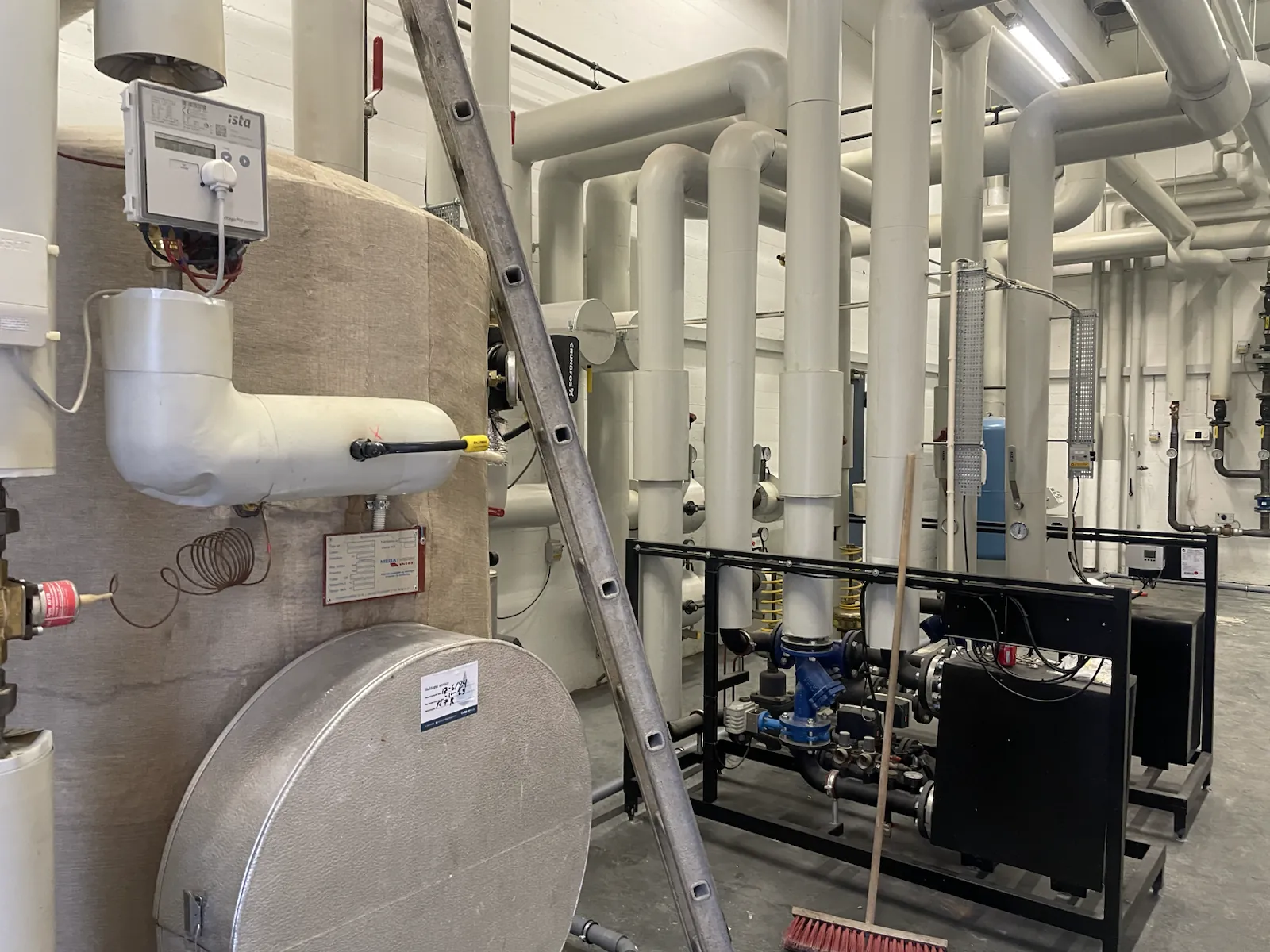
Containment can be a durable part of risk management, but it is different from removing the source. A sheet-pile wall needs inspection and corrosion protection. A hydraulic control needs wells, pumps, power, treatment, discharge arrangements, sampling, maintenance and people who understand the system. Monitoring must show whether the control still meets its objective.
At the old factory site, Region Midtjylland's 2026 programme includes checks after three and twelve months of the wall's cathodic protection, an electrical system that reduces corrosion of the steel, then annual checks. A construction project becomes a long-term asset-management obligation. Completion of the wall is not completion of remediation.
At Rønland, pumping contaminated groundwater changes the hydraulic conditions that govern migration. A handover cannot be reduced to pump manuals. The record should establish abstraction rates and water levels, treatment performance, discharge route, monitoring limits, outage response, spare capacity, access rights, data ownership and reporting. It should also show what changes if production water, staff, laboratories or site utilities are no longer available.
Harboøre Tange is unusual in scale, so its costs should not be projected onto an ordinary property. The transferable principle is narrower. If an acceptable environmental condition depends on an active measure, that measure belongs in the critical operating model for the transaction or closure.
What this means for property decisions
For an acquisition, operational closure, refinancing or redevelopment involving controlled contamination, the environmental workstream should produce a control-continuity schedule before the transition is committed.
A useful closing condition is not simply that "the system is operational" on one date. The evidence should show that the people, rights, utilities, information and money needed to keep it working remain available. If the long-term solution is undefined, the uncertainty needs an owner, timetable and commercial treatment.
Harboøre Tange demonstrates the discipline required at a smaller property: distinguish source from control, current performance from future continuity, and a technical measure from the arrangements that keep it working.
ACED Miljø can assess the technical condition, dependencies and monitoring evidence behind an environmental control. Decisions on legal responsibility, permit transfer, financial security and contractual allocation should be made with the relevant authorities and legal advisers.
- Separate sources and objectives. Map each source, pathway and receptor. State whether the measure removes contamination, contains it, controls groundwater movement or only monitors change.
- Record every dependency. Identify wells, pumps, treatment, drainage, power, chemicals, remote monitoring, laboratories, permits, discharge points, access, contractors, staff and data systems. Record what happens if one is unavailable.
- Verify performance, not existence. Review monitoring trends, maintenance, outages, alarms and compliance records. Confirm which data show that the measure works and whether they remain representative after the operational change.
- Define the transition state. Establish who will operate, fund, inspect, sample and report from the last day of current operations to the next stable arrangement. Legal advisers and authorities should confirm the basis for obligations and contractual provisions.
- Price the long-term position. Distinguish committed works from later ambitions, secured funding from expected funding, and containment from remediation. Include monitoring, renewal, energy, treatment, waste, access and contingency costs.
Official sources