Reconcile the register, the property files and the physical site
Consider a property where the Danish Building and Dwelling Register (BBR) shows one underground oil tank as closed, a historic drawing shows a tank in a different position and a fill pipe remains visible beside the building. None of those facts proves that a leak occurred. Together they show that the transaction team does not yet have one reliable account of what is in the ground, where it is or how it was taken out of use.
BBR and municipal files can contain valuable information about reported installations and closures, including tank certificates, sketches, installation notices, closure notices and correspondence from previous owners. Each document adds evidence, but none should automatically be treated as a current condition survey. The Danish Environmental Protection Agency notes that BBR tank information can be incomplete or inaccurate because it depends on reporting by owners and users.
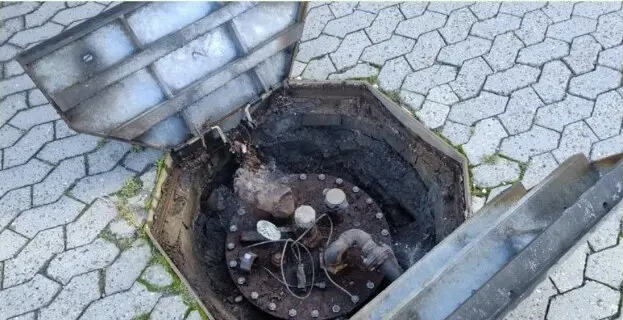
Record alignment is therefore an active task. Compare tank number, volume, product, material, installation year, location and status across every source. Then check whether fill points, vents, access covers, pipe routes, changes in surfacing and former heating arrangements support the same account. A precise-looking register entry can create false confidence when the underlying documents refer to different installations.
Tank uncertainty usually appears as a mismatch rather than an explicit warning. Resolving the mismatch early can prevent a buried installation or historic source area from becoming a surprise during excavation, refinancing or a later sale.
- A tank appears in BBR, but no closure certificate or location plan is available.
- A closure is recorded, but the method, removal of residual product or treatment of pipework is unclear.
- A fill point, vent or manhole is visible in a different location from the plan.
- Historic heating records suggest oil use, but no tank is registered.
- Several documents describe tanks without establishing whether they refer to the same installation.
- The proposed excavation footprint intersects the likely tank position or associated pipework.
Build the evidence in stages, then test what closure proves
A proportionate tank review usually begins with records, historic plans and site reconnaissance. Visible fill points, vents, access covers, pipe routes and changes in surfacing can help refine the likely position. Where uncertainty remains material, suitable detection methods can be used to locate buried metal or identify anomalous features.
If access can be created safely, further work may include inspection of accessible tank components, checking dimensions and orientation, or supporting opening, cleaning and condition assessment by appropriately qualified contractors. Soil sampling is a separate decision and should be placed where it can answer a defined leakage question.
Locating an installation, confirming whether its closure was compliant, assessing its present condition and investigating whether it leaked are related but different tasks. A metal-detection response may help locate a tank but says nothing about residual oil or surrounding soil. A closure notice may describe what was reported but not establish the current physical condition. A soil sample taken in the wrong position may fail to address the most credible release point.
The investigation plan should therefore state which question each step is intended to answer. This keeps the scope proportionate and allows the transaction team to stop when sufficient evidence has been obtained rather than moving automatically from a document gap to excavation.
Correct closure reduces future risk, but it does not prove that a historic release never occurred. Miljøstyrelsen warns that old unused tanks may still contain residual oil and can leak. It also states that the current owner must ensure that an installation taken permanently out of use is properly closed.
For a buyer, the issue is therefore both regulatory and commercial. The team should understand what was done, what remains in the ground, whether evidence of leakage exists and how future removal would interact with construction, utilities or contaminated-soil handling.
The surrounding infrastructure can matter as much as the tank shell. Fill pipes, delivery areas, overfill points, vents and supply lines can create release locations away from the tank itself. Historic oil use may also have involved day tanks or internal pipework that are poorly reflected in property records. A review limited to the registered tank position can miss those sources.
Future plans change the consequence. Leaving a correctly closed tank beneath an undisturbed yard may be compatible with continued use, while a new basement, drainage trench or utility route through the same area can turn location and soil condition into immediate design and cost questions.
Translate uncertainty into a proportionate property action
Not every uncertain tank record requires excavation before closing. The response may be a targeted survey, a seller information request, a contractual undertaking, an allowance in the development budget or a planned investigation when site access becomes available.
What matters is that the uncertainty is visible and owned. A short, well-framed tank note can be more useful than an unsupported statement that the tank is either safe or problematic. It should say what is known, what is inconsistent, what could change the risk assessment and when the next step should occur.
For an acquisition, the key distinction is often between a question that can be managed after closing and one that affects price, programme or the ability to carry out the intended works. The report should identify the likely tank location, confidence in closure evidence, potential release points, relationship to the project footprint and the evidence needed to reach the next decision.
For an existing owner, a structured tank record supports maintenance, emergency response and future transactions. New photographs, contractor documentation, waste records, investigation results and as-built information should be added when work is carried out. The objective is to replace inherited uncertainty with an evidence trail that remains useful throughout the property lifecycle.
Official sources