The new material is guidance, not a universal clearance rule
On 20 April 2026, the Danish Environmental Protection Agency issued an advisory statement setting a value of 100 milligrams of asbestos per kilogram of dry matter for soil. The value is defined as chrysotile plus ten times the concentration of amphibole fibres. The agency published its public notice on 27 April 2026.
On 8 October 2026, the agency published Asbestos in or on soil: management options. The report brings together current knowledge and practical experience for cases involving incorrect demolition or renovation, fires, inappropriate cleaning of asbestos-containing roofs, material in or on soil, buried material and, to a limited extent, water. It was informed by interviews with 13 municipalities and dialogue involving municipalities, regions and the agency.
The report is explicit about its status. It is a first proposal for administrative practice and a set of management options based on current knowledge and good practice. It is not a new act or executive order. It also identifies unresolved questions about background levels, movement of fibres in soil and water, air dispersion, sampling and practical use of the advisory value.
The number is inseparable from the sampling and analysis
The 100 mg/kg dry-matter value is based on a Dutch approach. The agency states that sampling, analysis and reporting should follow the associated Dutch methods. The report describes a combined process involving site history, visual assessment, a sampling plan and substantial mixed samples. It is not simply a laboratory method applied to any convenient handful of soil.
Material type and condition also matter. Asbestos may be present as intact or bound fragments, partly degraded fibrous material, or free fibres that are not visible. The referenced methods use different analytical techniques for bound material and free fibres because they do not answer exactly the same question. For a property decision, the important point is to match the investigation and analysis to the material and exposure question.
The report therefore warns against using an analysis in isolation. A result must be read with the event history, visible distribution, material condition, ground surface and exposure scenario. A sample that dilutes a small cluster of fragments into a large mass may not represent the question the property team is trying to answer. A different method or detection basis may also make an older report difficult to compare directly with the 2026 advisory value.
This does not mean that every property needs an extensive investigation. The report describes a proportionate sequence. Some cases can be closed after a desktop review where no credible event occurred. Others may be resolved after inspection. Soil investigation becomes relevant where material may be mixed into the soil, buried, degraded or distributed beyond what can be established visually.
Build the property evidence from source to ground
The first task is to reconstruct a credible source and event. Relevant records can include asbestos surveys, roof and facade replacement files, demolition and waste documentation, fire reports, roof-cleaning work, earthworks, imported fill, historic photographs, invoices and correspondence with the municipality or region. A record of asbestos in a building does not by itself prove that the ground was affected. Equally, the absence of an asbestos entry does not rule out historic material or an undocumented incident.
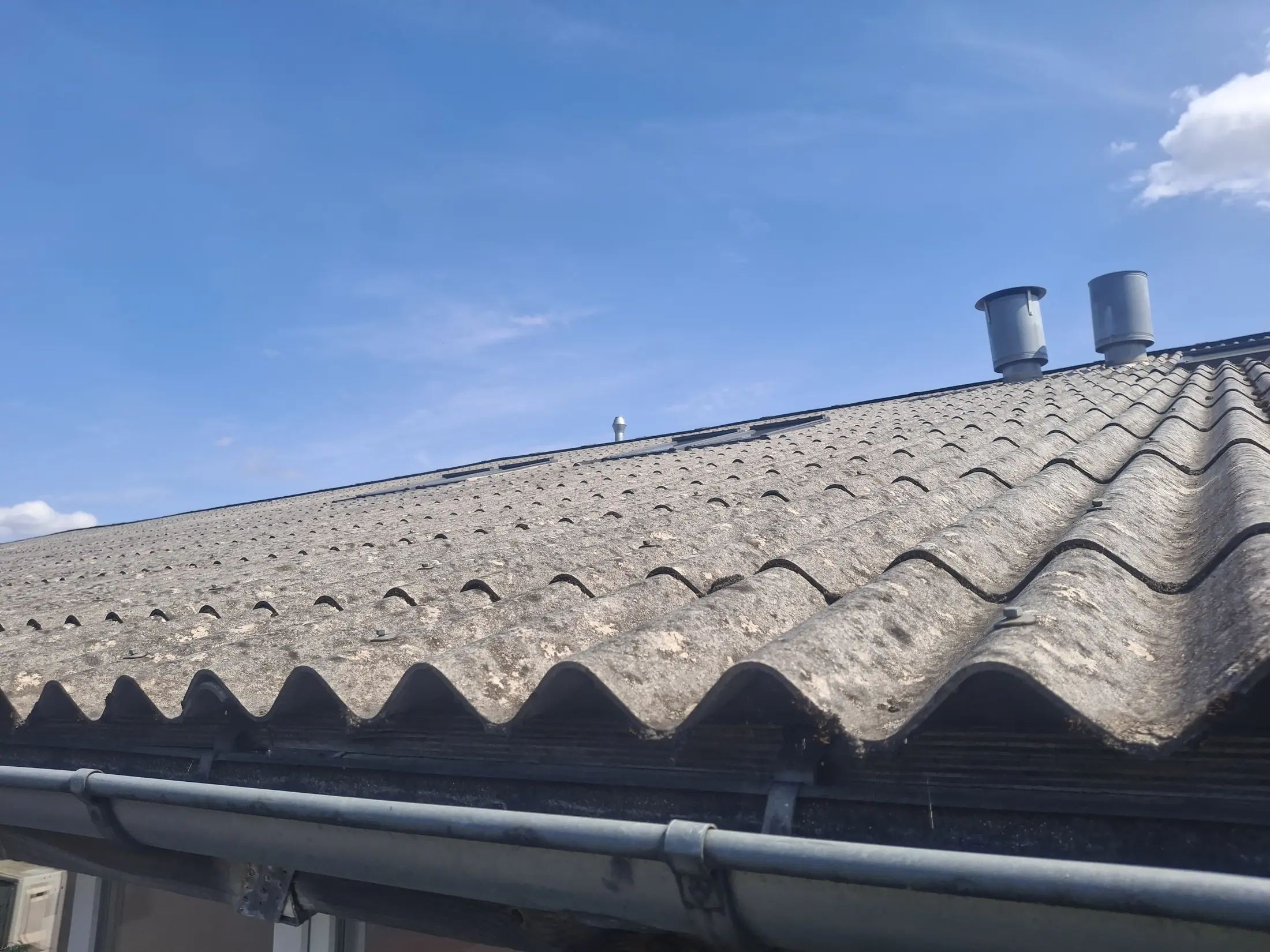
The site visit should test the record. Inspectors may need to consider visible fragments, whether material is intact or degraded, whether it lies on paving or is mixed with soil, the extent and pattern of distribution, disturbed ground, vegetation, drainage routes and the way the area is used. Buried material presents a different evidence problem from intact sheets lying on a hard surface.
That physical distinction can also affect the regulatory route. The 2026 report explains that material treated as part of the soil environment and material managed as waste may fall under different legislation. The same event can create both types of issue across different parts of one property. Classification and available statutory powers require a case-specific authority decision, not a conclusion based only on a laboratory certificate.
Building and soil workstreams should remain connected but distinct. A pre-refurbishment asbestos survey identifies materials that planned work may disturb. A soil assessment asks whether asbestos-containing material or fibres reached or became mixed with the ground. Completing one does not automatically complete the other.
What this means for property decisions
For an acquisition, request the building asbestos record together with demolition, roof-work, fire, waste, earthworks and soil files. Check whether the documents cover external areas and historic events, not only materials still present inside the building. Where a credible source and pathway remain, define the next investigation before treating the issue as either cleared or material to the transaction.
For redevelopment, put the boundary between building materials, waste and soil into the project plan. The tender and programme may need a pre-work building survey, controls for asbestos work, a procedure for unexpected fragments, a method for assessing affected soil and agreed handling or disposal routes. Work should stop in the affected area if unexpected suspect material is uncovered, until it can be assessed under appropriate health, safety and environmental controls.
For cost planning, do not price only from a concentration number. Extent, depth, condition, access, current and future use, worker protection, disposal route and authority requirements can change the cost. A result above the advisory value can justify further investigation and site-specific assessment. A result below it is useful only when the sample and method validly represent the area and decision.
For transaction reporting, state what happened, what was inspected, how samples represent the site, which method was used, what remains uncertain and what decision that uncertainty affects. Avoid unsupported conclusions such as "no visible fragments means no asbestos" or "the result is below 100 mg/kg, so the whole property is clear".
ACED Miljø can connect building history, site inspection and soil evidence within environmental due diligence and redevelopment planning. The relevant authority and legal advisers should confirm the regulatory route, responsibility and any required approval or remedy for the specific property.
Official sources