One PCB finding can create four different property questions
A laboratory result from a sealant or floor material does not, by itself, define the property consequence. The result may be relevant to whether material can remain in place, whether occupied rooms need an indoor-air assessment, how future work must be planned and how removed material must be classified and handled. Each question has a different evidence base.
This matters in a transaction because a short statement such as "PCB has been identified" can conceal very different positions. The material may be intact and outside the current project area. It may be within a planned facade or floor replacement. It may have affected adjacent porous materials. It may also be associated with an indoor-air concern that cannot be resolved from the material concentration alone.
The country matters as well. Sweden's PCB ordinance contains explicit investigation and removal provisions for certain joint sealants and slip-resistant floor masses used in buildings or facilities constructed or renovated during 1956 to 1973. Denmark's current building-waste rules require environmental screening before defined building work and environmental mapping where the screening indicates a risk of problematic substances. These are not equivalent legal triggers.
A useful review therefore separates four questions: what contains PCB, whether exposure is credible, what planned work will disturb, and which notification, removal, waste and record duties apply. Combining them into a single red, amber or green conclusion can obscure the action the buyer or owner actually needs to take.
In Sweden, start with the owner's inventory and removal record
Swedish Ordinance 2007:19 requires the owner of a building or facility where joint sealant or slip-resistant floor mass may have been used during construction or renovation from 1956 through 1973 to investigate whether the material is a PCB product, subject to the ordinance's stated exceptions. The inventory reporting deadline and the principal removal deadlines for material above 500 parts per million are historic. For a current acquisition, their value is diagnostic: the data room should show whether the property fell within scope, what was inspected, what analysis was completed and what removal or exception record followed.
An absent inventory is not the same as a negative inventory. Nor does an old spreadsheet necessarily prove that the present building was fully assessed. Extensions, facade zones, concealed joints, floor systems and later discoveries may sit outside the recorded scope. The review should reconcile the inventory with drawings, construction dates, alteration history, laboratory reports and the building as it exists today.
For relevant joint and floor masses above 500 parts per million by weight, the principal removal deadlines were 30 June 2014 or 30 June 2016. There are exceptions, including certain replacement masses installed after a PCB product was removed after 1998, and authority-approved deferrals. Material containing 50 to 500 parts per million by weight must be removed no later than renovation, rebuilding or demolition. Notification to the supervisory authority is required at least three weeks before removal under these provisions. The municipality normally supervises the work. Review any exemption or deferral decision before concluding that retained material demonstrates non-compliance.
The building provisions have defined limits. They exclude qualifying one- and two-dwelling houses and associated outbuildings owned by natural persons or estates. Equipment has separate rules. An inventory of joint sealants and floor masses should therefore not be presented as confirmation that every potential PCB source at the property has been assessed.
Removal can also leave a continuing technical question. The Swedish Environmental Protection Agency notes that replacement joint sealant may be recontaminated as PCB migrates from adjoining material. A completion record should therefore identify not only the removed primary material, but also the treatment of adjacent substrates, retained concentrations, waste route, quality control and any future inspection or removal trigger.
In Denmark, connect the assessment to the planned building work
Danish Executive Order no. 496 of 21 May 2024 requires the client to carry out an environmental screening of the building or affected parts before covered building work. If the screening gives reason to suspect problematic substances, the client must ensure that an environmental mapping is completed. Covered building work includes demolition, renovation or maintenance expected to generate more than one tonne of waste, and replacement of insulating glazing units that may have been manufactured from 1 January 1950 through 31 December 1977.
For work following the ordinary waste-notification process, the client submits the notification to the municipality before starting. Subject to other required permits, work can begin once the municipality accepts it or at the earliest two weeks after submission. Larger demolition projects can follow a different route: where the fully removed floor area is at least 250 square metres, the rules on selective demolition and a standardised demolition plan apply. That plan replaces the ordinary waste notification and has its own submission and start conditions. The two-week period should therefore not be used as a universal demolition timetable.
Notifications and demolition plans must be updated when significant new information emerges. Screening and mapping should happen early enough for the results to inform design, tendering, segregation, waste recipients and programme. The exact notification route should be established before the contractor's start date is fixed.
Danish Environmental Protection Agency guidance identifies joint sealants and insulating glazing as important historic PCB uses and explains that PCB-containing material should be separated before renovation or demolition. The Danish Working Environment Authority also expects PCB to be investigated before work and the work to be planned so that exposure through dust, vapour or skin contact is controlled. The waste and worker-protection questions need a common material record, but they lead to different controls and responsibilities.
A project threshold should not be mistaken for an indoor-air threshold. PCB can migrate from a source material to indoor air and to nearby surfaces or materials. Where building use, source condition or other evidence indicates a credible exposure question, indoor-air assessment is a separate decision. Conversely, an air result does not map all materials that will become waste during a refurbishment.
A defensible investigation follows history, zones and decisions
The investigation should begin with the decision it must support. For an acquisition, the priority may be the completeness of the owner's compliance record and a cost allowance for future work. For refurbishment, the priority is a material map aligned with every element to be disturbed. For an occupied building, the first question may be whether a credible source and pathway justify indoor-air measurements or immediate precautions.
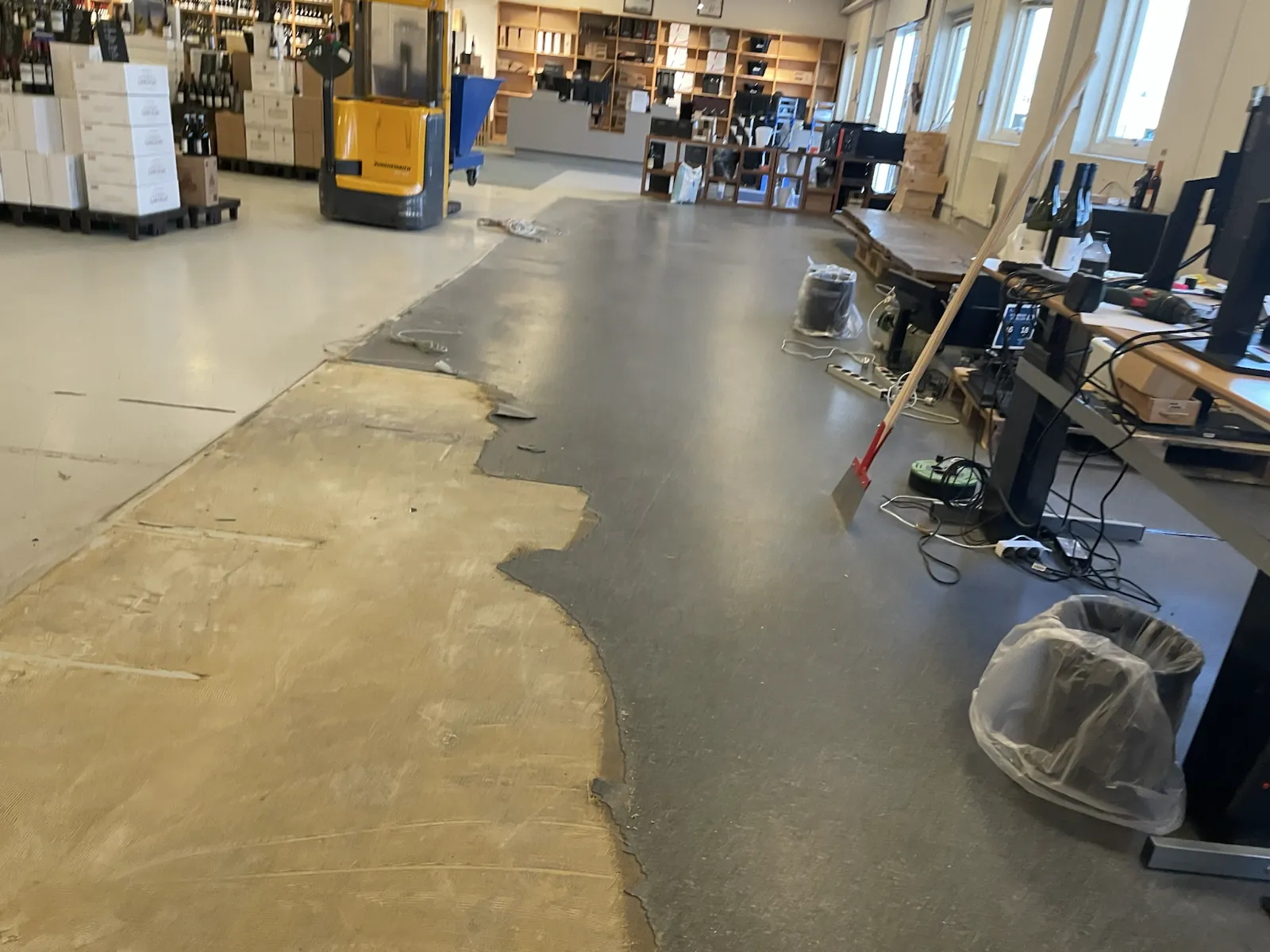
Desk study and site inspection should establish construction and alteration periods, facade and window systems, floor build-ups, technical equipment, previous removals and the exact work boundary. Sampling locations should represent distinct material types and construction zones. Composite or convenience sampling can dilute a localised result or make it impossible to assign the result to a waste stream. Visual similarity is useful for defining groups, but it cannot substitute for analysis.
The report should state what was accessible, what was sampled, which areas were outside scope and how results were interpreted. The laboratory's reported PCB sum, calculation method and units must match the basis of the criterion being applied. A material result in milligrams per kilogram cannot be compared directly with an air result in nanograms per cubic metre. The report should also distinguish primary source materials from potentially affected adjoining materials. After removal, photographs, analytical schedules, waste documentation and marked-up plans should allow a later owner to understand what remains.
For a Danish and Swedish portfolio, the technical survey can share a common data structure while preserving country-specific fields. Each record should identify location, material, concentration, condition, adjacent materials, occupied-space relevance, planned disturbance, required notification, waste route, action and evidence of completion. That structure makes properties comparable without pretending that their legal pathways are identical.
Turn the PCB record into a transaction and project plan
The commercial issue is rarely the presence of PCB in isolation. It is the combination of quantity, location, exposure potential, planned disturbance, legal status, programme and quality of the existing evidence. A defined issue with reliable drawings and completion records may be easier to price than an undocumented building from the relevant period.
Before signing or closing, material uncertainties should be assigned to a practical action. That may be a targeted survey, an indoor-air assessment, authority dialogue, a costed removal scope, a seller deliverable, a retention or a documented assumption in the refurbishment budget. Legal advisers should confirm responsibility and contractual allocation. Technical evidence should make those decisions specific enough to enforce and price.
A cross-border portfolio does not need two unrelated processes. It needs one evidence standard with two regulatory pathways. The common standard establishes where PCB is, what it can affect and what remains uncertain. The country-specific pathway establishes what the owner must notify, remove, retain or demonstrate.
ACED Miljø can help property teams review building history, define investigation needs and turn technical findings into a practical action plan. For a Swedish asset, the scope should identify the local expertise and authority dialogue needed to confirm property-specific requirements.
- Verify scope before relying on an old inventory. Match construction periods, zones and sampled materials to the present building and the planned work.
- Separate current occupation from future disturbance. Indoor-air evidence, material mapping and waste planning answer different questions.
- Price retained material as a managed condition. Record its location, concentration, condition, trigger for later removal and implications for adjoining materials.
- Build notification periods and authority review into the programme. Swedish PCB removal and Danish building-waste notification do not use the same trigger or timetable.
- Require a usable completion record. Marked-up plans, photographs, laboratory data and waste documentation should show what was removed, what remains and where follow-up is required.
Official sources